This page is the honest inventory. Everything in the sections below is built and running — in a real household, on real hardware, today. The things we haven’t built yet are at the bottom, labeled as such. In a category where every brochure over-promises, we’d rather you know exactly where the line is.
If you read one thing: the system is organized around four questions a family asks every day. Everything — the hardware, the software, the alerts — exists to answer them without anyone having to ask.
Open the app and the top of the screen is a plain-language answer board. Not charts you have to interpret — answers. And when the house is too quiet, the board says so loudly: silence is treated as a finding, never as “nothing to show.”
The dispenser doesn’t log when the alarm rang — it detects when the pills were physically picked up. The dashboard shows each dose as it actually happened: taken on time, taken late, still waiting, or overdue — and the dispenser itself reports an overdue dose at the thirty-minute mark, even if the internet is having a bad day.
When something jams the tray or a dose can’t go out, the family sees it as a blocked dose with a one-tap resolution — including a caregiver skip that advances the tray and marks the dose so the record stays truthful.
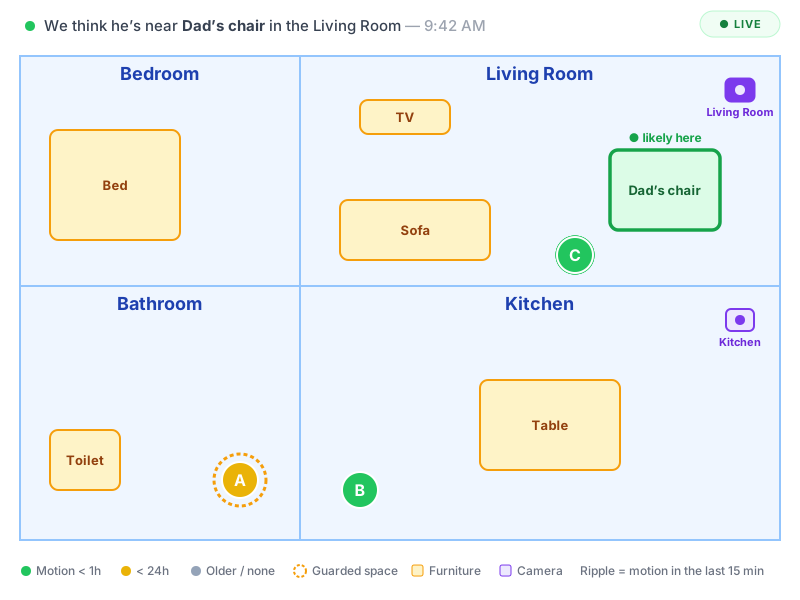
Motion sensors report to a floor plan of the home that the family draws once, in the app — rooms, the bed, his usual chair, where each sensor sits. The dashboard then answers in words: “We think he’s near his chair in the living room — 9:42 AM,” with a live view that updates itself as motion happens.
Every motion event is recorded by room — kitchen, bathroom, bedroom — building the day-by-day record of his routine.
Caregivers check in and out with a QR code by the door — framed as a timesheet, because that’s what it is. The family sees shift start and end as it happens, and the schedule shows who’s on today, who’s on tomorrow, and which shifts are still open.
The full coordination layer lives alongside it: the caregiver roster, shift tasks, appointments, the supply list, and a care-notes feed every caregiver reads and writes — so the handoff between shifts stops living in text messages.
When the emergency button is pressed, everything fires at once: the base station in his home sounds and lights up, the remote indicator in your home turns red and sounds, the app updates within a second, and your phone gets a push notification that wakes the screen. Acknowledging the alert from the app quiets every device in the chain.
Every alert — button press, missed dose, blocked dispenser — is kept in a permanent record with who acknowledged it and when.
Six devices, one family. Everything battery-powered runs for months between charges; everything talks to the base station over its own local radio link, so the system keeps working through the family WiFi’s bad days. Setup is done by the family in the app — no technician visit required, though early households get one anyway.
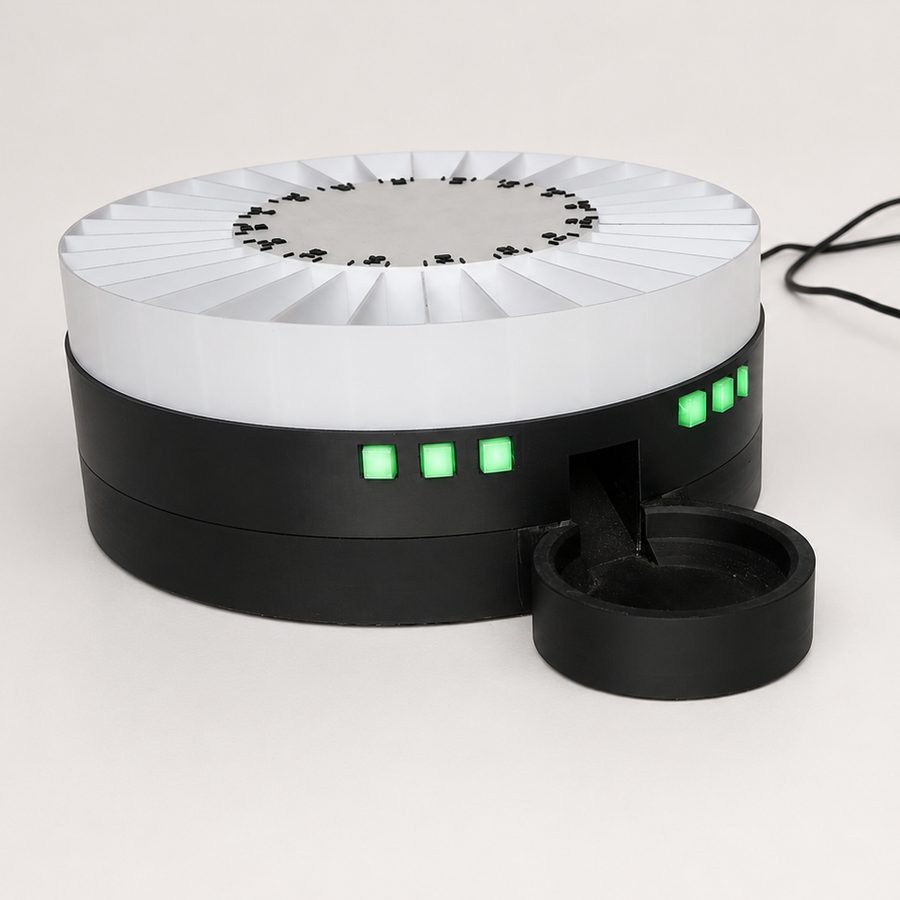
The hub in the parent’s home. Coordinates every device, routes alerts to the right people, and shows the household’s state on a quiet ring of light. Sounds and lights up when something needs attention; otherwise you forget it’s there.
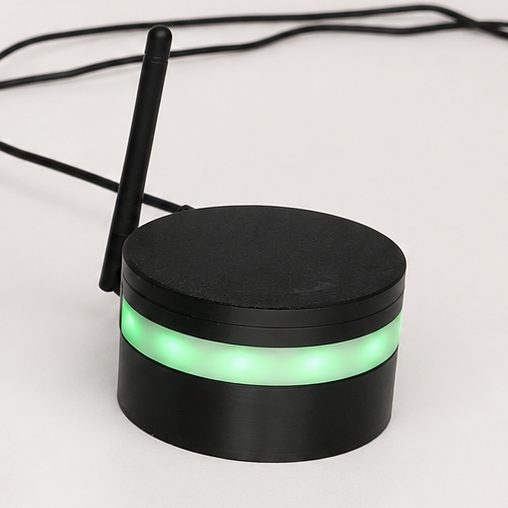
The same device as the base station — but it sits in your home, maybe hundreds of miles away. Its colors mirror the dashboard: green when things are fine, yellow when something needs attention, red when something is wrong. When the emergency button is pressed at your parent’s house, this device sounds in yours. One per family member who wants one.
A 32-slot rotating tray that dispenses on schedule and — the important part — detects when the pills were physically picked up. Keeps its own clock and schedule, so a dropped connection never means a missed dose. A status ring shows plainly whether a dose is waiting.
Small, battery-powered, and placed room by room — the bedroom, the bathroom, the kitchen path. They sleep between events to stretch battery life to months, and they automatically pause their pattern-recording during caregiver shifts so the record reflects his day, not the housekeeping.
One button, battery-powered, wakes from sleep the instant it’s pressed. Single, double, and long presses can mean different things. It reaches the base station on the local radio link — not the WiFi — and the alert lands on every family device within about a second.
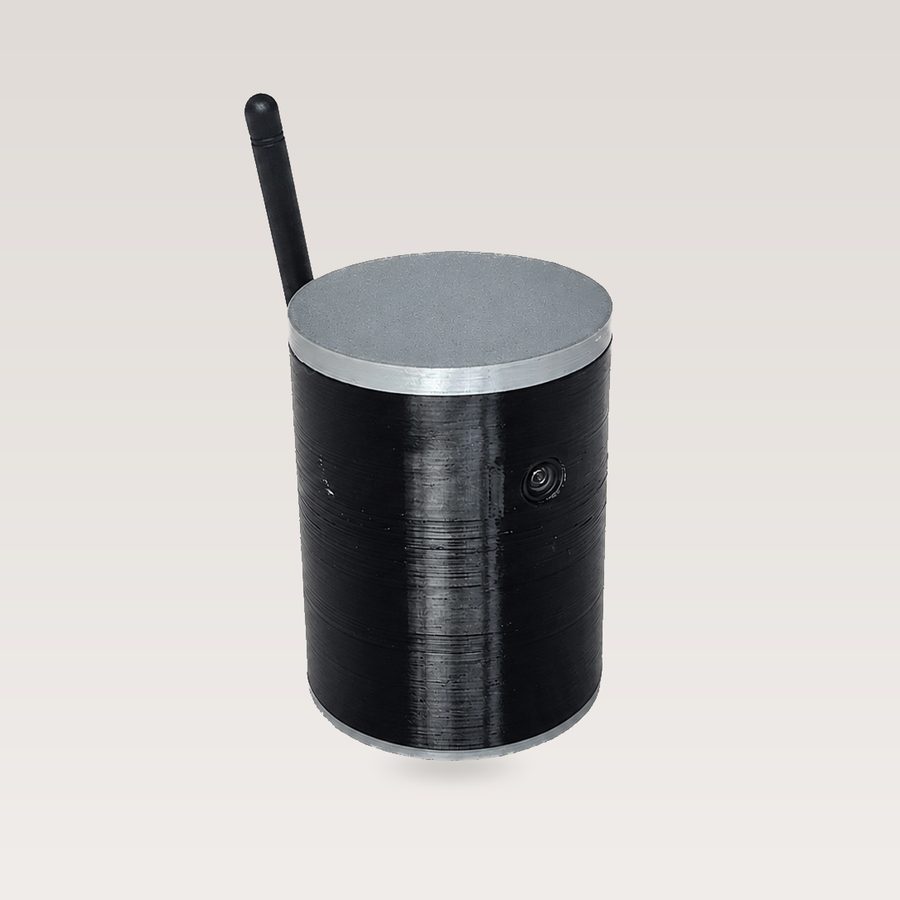
Takes a still photograph when something needs visual context — never a recording, never audio. On the family’s floor plan, the camera covering the room with the most recent motion is the one the app shows first. Some households want it, some don’t; both work fine.
The platform can also reach the lights. The system integrates with inexpensive WiFi smart bulbs: a light can come on automatically when he gets up after dark — the single cheapest fall-prevention measure there is — and every alert-enabled bulb in the house flashes red on an emergency. No hub, no extra subscription; the bulbs are twenty dollars at a hardware store.
A web app that installs to the phone like a native app, organized into five areas. Every family member gets the view that matches their role — the sibling running things sees the dense operational picture, the one helping sees summaries and alerts, and caregivers see their shifts and tasks without seeing the family’s private conversation.
Medications with schedules, criticality, and pickup windows. Every dose event as it happened. Blood pressure, weight, and heart-rate logging with trend charts. Physical-therapy exercises with daily check-off. A guided tray-filling workflow that verifies each slot as it’s loaded.
The live floor-plan view with room-by-room motion history. Camera captures with full history. The alert center — open, acknowledged, and resolved, with notes.
The caregiver roster with agency and rate details. Shift scheduling with QR check-in. Appointments and recurring schedules. The household supply list. Care notes that carry across shift changes, and a family-only chat that caregivers never see.
Guided first-time setup — create the household, claim the base station, add devices, type the home address and the system finds it on the map. Five distinct access roles. Short-lived emergency credentials to hand an ER nurse. Every device’s battery level and last-seen status in one place.
Under the hood, for those who ask: alerts travel over an encrypted real-time message channel and land in the app in under a second; phone notifications use standard web push, so there’s no app store between the family and an emergency. Every device signs its reports with its own cryptographic key. Times display in the household’s timezone no matter where the family member is. The record of alerts and who acknowledged them is permanent.
The same honesty in the other direction. These are the next things on the platform’s path — designed, and in some cases partially plumbed, but not something a family can use today.
The system already records the raw material — room-by-room motion, dose timing, sleep-adjacent patterns. The next step is learning what’s normal for him and quietly flagging drift: bathroom trips creeping up, mornings starting later. This is the headline of where the platform is going, and it’s honest to say it needs weeks of accumulated data before it can be honest with you.
A summary for the family member who doesn’t want to check an app — here’s what the week at Dad’s looked like, delivered to their inbox.
The one-page baseline summary for the discharge nurse, medication changes staged before he’s home, caregiver hours ramped for recovery. The pieces exist as data; the workflow that assembles them at the moment a family needs it does not, yet.
For the running log of what shipped and when — including what was proven on real hardware in a real household — see the progress page.
We’re installing in a small number of households at a time. If your situation sounds like the one this was built for, tell us about it.
Talk to us about your household